Menu management with AI import — poora menu, minutes mein.
EasyKOT's menu management runs your whole menu from one place — categories, prices, Half/Full portions, add-ons, veg/non-veg marks, stock-outs — and gets it into the system without typing: drop your menu as a PDF or photo, AI reads the dishes and prices, you review the grid, and it's live on every screen.
PDF · photo · CSV/Excel · 245-dish master library · nothing saves until you approve it
Drop the menu. Check the grid. Done.
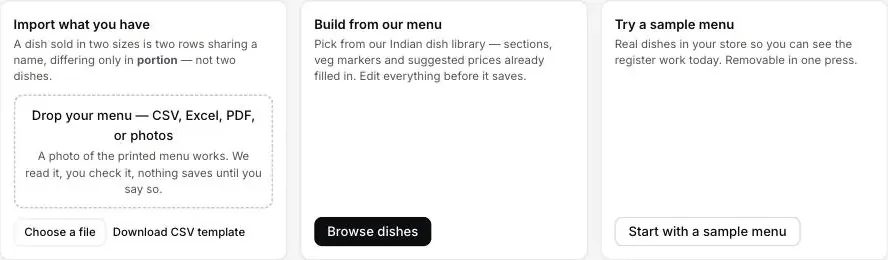
- 1 · Upload anything you have — the printed menu's PDF, photos of its pages, or a CSV/Excel export from your old system.
- 2 · AI reads it — dish names, categories, Half/Full prices — into an editable review grid.
- 3 · You check, then approve. Nothing goes live until you say so. Fix a name, correct a price, drop a dish — the grid is yours before it's the register's.
- Proof, not promise: on our pilot restaurant's 321-item menu, the import read every price correctly — and the review pass is still there for the day a photo is blurry.
Change it once. It changes everywhere.
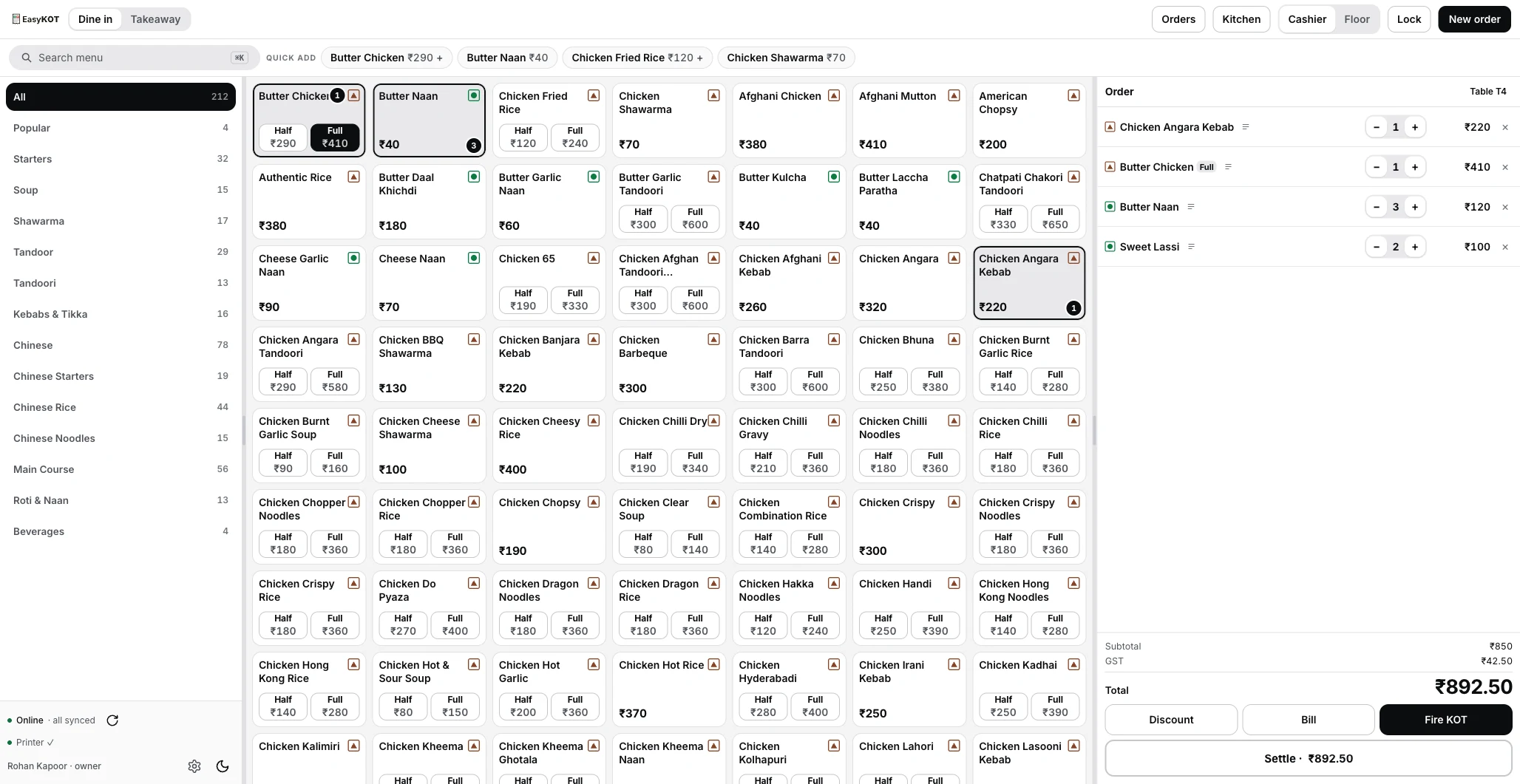
- Live on every surface. The approved menu appears on the billing register, every captain phone and the kitchen's KOTs — one source of truth.
- Price changes sync themselves. Edit in the dashboard; registers pick it up (there's a manual Sync menu button when you want it now).
- Stock-out in one tap. Mark a dish out and it leaves every screen until you bring it back.
- Indian menu structure is the default — Half/Full portions, add-ons, veg/non-veg marks on every tile, categories the way your menu card reads.
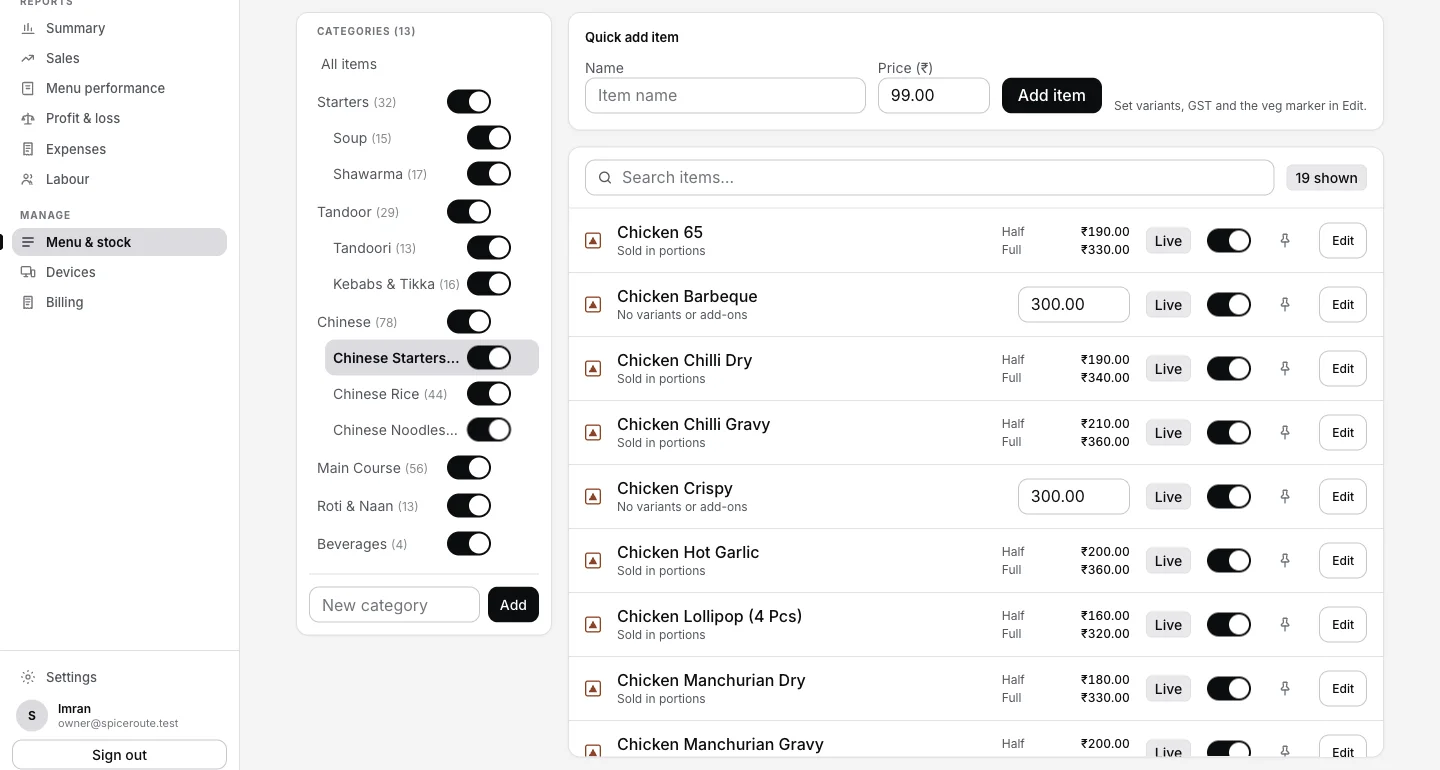
Menu & stock in the owner dashboard. Live is the stock-out switch — flick it and the dish leaves every register and captain phone until you flick it back. Categories carry their own counts, and nest the way a menu card reads.
One dish, opened up
- Veg, Non-veg or Egg — the mark that then shows on every tile, every KOT and every bill. India's rule, not an afterthought toggle.
- Price excluding tax, and the GST slab beside it — with the final price including GST spelled out underneath, so nobody has to do the arithmetic to know what the customer pays.
- Portions are shared across the menu — Half and Full are defined once for the whole card, and each dish just fills in its two prices. That is why adding a size later does not mean re-typing your menu.
- Variants and add-on groups for the dishes that need a choice or a paid extra — and nothing for the ones that don't.
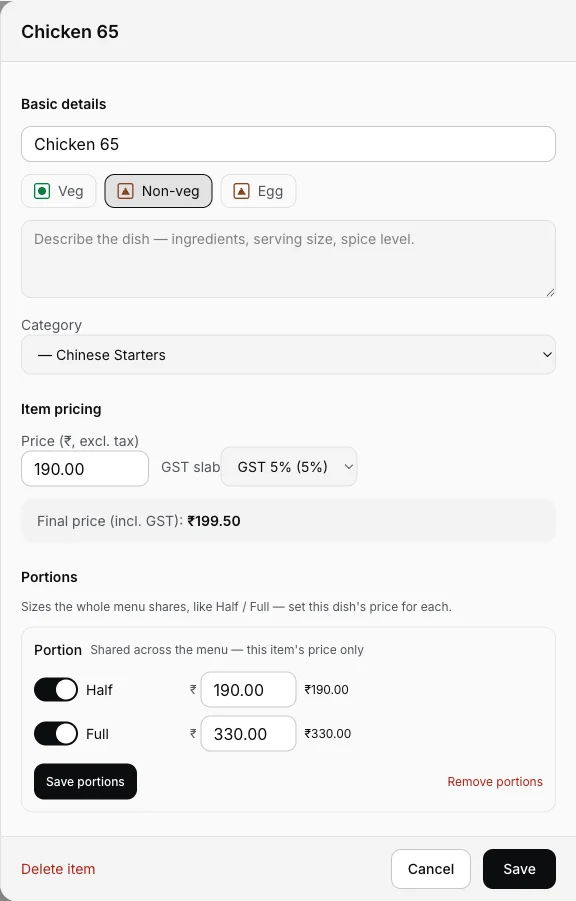
The dish editor — veg mark, GST slab, and Half/Full prices on one screen.
Straight answers.
What can I import the menu from?
How accurate is the AI import?
How do price changes reach the register?
Can I mark a dish out of stock?
Does the menu handle Indian menu structure — portions, add-ons, veg marks?
How long does menu setup really take?
The menu is step 2 of setup — see the whole signup-to-first-bill walkthrough.
3 mahine chalao, phir paisa lagao.
Three months free, full product, no card. Made in India, for the counter — built inside a running restaurant.